
Student Cluster Competition

2019 Competition
Denver, Colorado
Competition Applications
(Links to 2015, 2016, 2017, 2018 Applications)-
LINPACK Benchmark
http://top500.org/project/linpack/
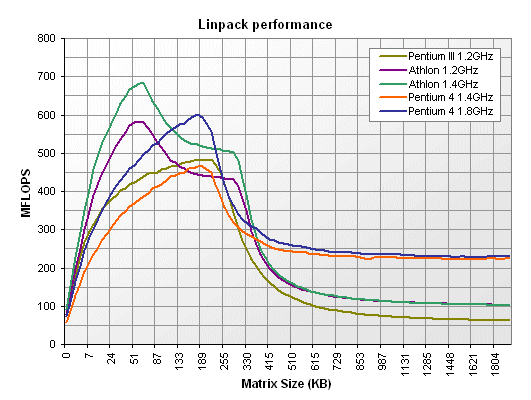
The Linpack Benchmark is a measure of a computer’s floating-point rate of execution. It is determined by running a computer program that solves a dense system of linear equations. It is used by the TOP 500 as a tool to rank peak performance. The benchmark allows the user to scale the size of the problem and to optimize the software in order to achieve the best performance for a given machine. This performance does not reflect the overall performance of a given system, as no single number ever can. It does, however, reflect the performance of a dedicated system for solving a dense system of linear equations. Since the problem is very regular, the performance achieved is quite high, and the performance numbers give a good correction of peak performance.
- HPCG Benchmark
http://hpcg-benchmark.org/
The High Performance Conjugate Gradients (HPCG) Benchmark project is an effort to create a new metric for ranking HPC systems. HPCG is intended as a complement to the High Performance LINPACK (HPL) benchmark, currently used to rank the TOP500 computing systems. The computational and data access patterns of HPL are still representative of some important scalable applications, but not all. HPCG is designed to exercise computational and data access patterns that more closely match a different and broad set of important applications, and to give incentive to computer system designers to invest in capabilities that will have impact on the collective performance of these applications.
- IO-500 Benchmark
https://www.vi4io.org/std/io500/start
Teams will run a scaled-down version of the IO-500 benchmark as an experiment this year. All teams that complete the benchmark will get full credit, and the team with the top performance will get a small bonus to their score.
- VPIC
https://github.com/lanl/vpic
VPIC is a general purpose particle-in-cell simulation code for modeling kinetic plasmas in one, two, or three spatial dimensions. It employs a second-order, explicit, leapfrog algorithm to update charged particle positions and velocities in order to solve the relativistic kinetic equation for each species in the plasma, along with a full Maxwell description for the electric and magnetic fields evolved via a second- order finite-difference-time-domain solve. The VPIC code has been optimized for modern computing architectures and uses Message Passing Interface (MPI) calls for multi-node application as well as data parallelism using threads. The current feature set for VPIC includes a flexible input deck format capable of treating a wide variety of problems. These include: the ability to treat electromagnetic materials; arbitrary, user-configurable boundary conditions for particles and fields; a suite of "standard" diagnostics, as well as user-configurable diagnostics; and flexible checkpoint-restart semantics enabling VPIC checkpoint files to be read as input for subsequent simulations. VPIC has a native I/O format that interfaces with the high-performance visualization software Ensight and Paraview.
The simulation cases for SCC19 will focus on the interaction of laser beams with ionized plasmas, typical of the particle-interactions seen during fusion energy experiments. Typically, such simulations directly target real world experimental equipment throughout the world, and are key component to understanding the observed behavior of fusion energy experiments. Numerical simulation allows us to directly interrogate any aspect of the system evolution, including those which are very difficult, or even intractable, in the physical system. Large-scale VPIC runs have been demonstrated to scale to thousands of nodes; millions of MPI ranks; and trillions of particles, representing cutting scale novel science development.
- SST
http://sst-simulator.org/SSTPages/SSTMainDocumentation/
The Structural Simulation Toolkit (SST) is a tool to simulate current and future computer system designs. It allows a user to look at a given instruction set architecture (ISA) and the surrounding cache and memory hierarchies on the system, plus programming models and communication models of larger scale multi-element future systems. The software is fully modular to enable simulation of new processor microarchitectures, novel new ISA features, and unique memory hierarchies and NUMA domains. The code is parallelized via MPI to enable simulation of large scale systems or in-depth simulation of smaller scale features.
- Reproducibility Challenge
Once again, students in the cluster competition will be asked to replicate the results of a publication from the previous year's Supercomputing conference. For this challenge, you will take on the role of reviewing an SC18 paper that contains an Artifact Description appendix to see if its results are replicable.
For the past four years, SC has promoted the adoption of the Artifact Description (AD) policy endorsed by ACM. The conference has selected one of the papers from the past edition to become the benchmark for the SC SCC reproducibility challenge. The competitive selection includes the review of all the past edition SC papers with AD and the in-person interview of the finalist papers' authors.
Teams will reproduce results from the SC19 paper "Computing planetary interior normal modes with a highly parallel polynomial filtering eigensolver".
-
Mystery Application

At the start of the competition, teams will be given an application and datasets for a mystery application. Students will be expected to build, optimize and run this mystery application all at the competition.
- Power Shutoff Activity
Some time during the 45 and 1/2 hours of the general competition the power will be shut-off at least once. The exact timing of the shutdown(s) are secret and may happen day or night. You and your team will need to know how to bring the hardware and software back from a full unscheduled power outage and how to resume any workload you were processing at that time. This exercise is designed to simulate real world events that system staff must respond to. This activity will allow your team to demonstrate their systems skills by recovering the system.
This has happened before. During the first Student Cluster Competition, in 2007, the power to the Reno Convention Center suddenly failed. The entire show floor went dark. It turned out that the power coming to the convention center was inadequate for Supercomputing's high-performance machines.Power was out for an hour or so, followed by what the press described as "the world's largest reboot". After the conference, crews were seen laying additional power cables across Virginia Street.
Our competition clusters, of course, went down. When the power was restored, some teams, who had been checkpointing their systems, resumed their computations quickly. Other teams, who had not been saving data, lost many hours of work and had to start over. The experience prompted discussions about checkpointing in the real world—the tradeoff between protecting against possible disasters at a cost of reducing computations.
Since power and other failures are the realities of modern computing systems, we would like to encourage cluster teams to understand the tradeoffs, and to consider what is needed in real life. We turn this thought-provoking accident into an activity to capture the think-on-your-feet spirit of the first competition.
Details:
The power will be shut off at the breaker to both monitored circuits for all teams. Once the power is shut off, all teams will be asked to leave their booths, and each booth will be inspected to make sure that everything is powered off. All teams will be let back in their booths at the same time to begin the procedures for recovering from the power failure. The full power-off and restoration logistics will be provided on site before the competition begins.
Some rules to be aware of:
Only the undergraduate team members are allowed to participate in bringing the system back up. No vendor or advisor help is allowed. Advisor rules listed here.- The advisor is not allowed to provide technical assistance during the competition, however, he/she is encouraged to run for food and snacks for their team and cheer during the long nights.
Any hardware failures can be swapped based on the rules listed here.- No changes to the physical configuration are permitted after the start of the competition. In the case of hardware failure, replacements can be made while supervised by an SCC committee member.
Battery backups are prohibited in the competition this year.- No battery backup or (Uninterrupted Power Supply) UPS systems are allowed to be used during the competition.
Teams that are not present in their booth will need to restore their clusters once they return.- In this instance, clusters will be unplugged from the SCC PDU by the SCC committee after power is shut down and the cluster will remain unplugged until the team returns.
SCC committee initiated power shutdown will not happen during setup or benchmarking. Please let us know if you have any questions.
- Poster Session (Judging Criteria)
The Overall SCC Winner will be the team with the highest score when combining their correctly completed workload of the four competition applications, mystery application, best benchmark run, application interviews, and HPC interview. The HPC interview will take into consideration the team's participation in the SC19 conference as well as their ability to wow the judges on their competition know-how.
Teams will be required to attend other aspects of the convention beyond the Student Cluster Competition, which will be included in their final score. Further details will be provided before the competition.